What is the CAGED system? In my opinion it’s something that gets too much attention for the wrong reasons and not enough attention for the right ones. A lot of guitarists haven’t even heard of it. (Have you noticed how I always have to get my little rant out of the way first in every article) 🙂
This is not going to be an in depth article simply because as far as I’m concerned the CAGED system doesn’t deserve one. Why? Because it’s five chords and nothing else, it is not a system and it won’t make you a great guitarist overnight. What it is, is something that you should just know and think about but certainly not restrict it to just five major chords. The whole idea of the CAGED system (in most teachings) is a method to use chord patterns, that you already know, as a guide to finding your way around the fretboard and relating them to major scales. The basic idea is a good one and has it’s uses but it’s not a system, it’s just common sense that will unfold as you progress. As a beginner it is a lot to think about.
Another problem I have with the way it’s (generally) taught is that it’s centred around the Major triads and major scales. The idea itself can be used with any scale and any chord.
CAGED Guitar system summarised.
C A G E D refers to the five common open chords (major triads) that most guitarists are taught from the beginning.
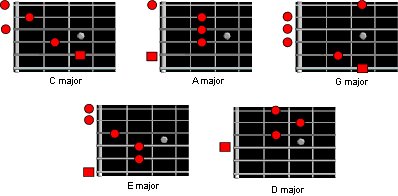
The A and E major chords are often moved anywhere on the neck, what we all know as barre chords. The C, G, and D chords aren’t moved as often, especially among beginners because they are difficult to finger and require difficult stretches. The thing with these chords is it doesn’t matter how difficult they are to play you should still know how to locate there positions anywhere on the neck. I’ll speak about this in a moment but for now I’ll just get on with the summary, which is nearly done anyway 🙂
Learning to locate these five chords in any position on the neck is generally easier than learning to locate the five most common major scale patterns anywhere on the neck, I personally disagree with this because it’s much more involved in real world guitar playing but I can see the logic and yes, it does have it’s uses but I think we should drop the word “system” and replace it perhaps with something like “guide”.
If you already know the five chord patterns above and think you can locate them reasonable quickly anywhere along the fretboard then take a look at the diagrams below because this is the CAGED system in a nutshell. Learn the chord shapes, learn how the chord shapes integrate with the major scale patterns below and then decide yourself how much a better guitar player you are now you have learned the CAGED system, I doubt you’ll find many Eureka moments.
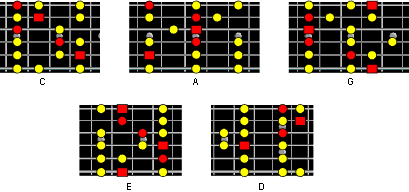
Even though it might sound like it, I’m not knocking the idea, it’s just the way it’s taught like so many things in the guitar world, mishandled, incomplete or borderline pointless just to create more content to fill books.
So what should you know about the “system”. I think the main thing is to not waste any time specifically learning it as it’s taught above.Learning scales and chords and finding ways to relate them to each other is a natural part of the learning process and it takes time, a long time. Also think of CAGED as a foundation, not just major and not just triads. Over time you will want to naturally integrate and relate all varieties of chord and scale types, let this happen naturally don’t try to rush it, even after years of playing there will always be more ways of looking at the fretboard, I’d go as far as saying it’s never ending.
What is important to learn is the foundation, being able to find these chords anywhere on the fretboard quickly is extremely important. Spend time learning this and the integration part will happen all on its own and will happen slowly. The chord tone series in the practice sessions are aimed at doing just this, learn slowly and build your experience in small steps.
Tips for learning the CAGED chords
I’ve covered barre chords elsewhere and most guitarists understand them even if they cannot play them yet but what about the other three that so often get ignored? The reason they are ignored is because they are difficult to play. Simple answer, stop making them difficult. Break them down into smaller manageable chunks and start using them in your playing. You don’t need to use all six strings every time you play a chord, if a chord is difficult then split it up into two small independent chord shapes. If you do this with the G form chord you will have one of the chord tones missing (in the yellow part). Don’t let that stop finding ways to use it, worry about it only if it starts to sound wrong, most of the time it won’t.
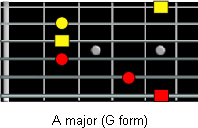
The D form is a slightly difficult stretch. Until you get used to it, dump the use of the D string and use just the three notes outlined in yellow. Try not to use your index finger at all even though it’s more difficult. Once you can play the chord this way it will be easier to put the index finger back on the D string.
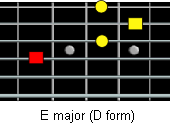
If you split the C major form then one half of it becomes the D form. Getting used to these kinds of relationships are also very useful
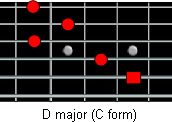
That outlines the basic concept of the CAGED system. Don’t try too hard to make more out of it than what it is because without trying, the idea will probably become a large part of how you think your way around the fretboard anyway. It certainly won’t be restricted to major scales and triads.
If you really want to become a master of the fretboard then the best way to do so is through practice. Being able to play guitar solos and melodic phrases that always blend perfectly with the music and sound professional is one of the best skills you can learn. Starting with simple chord tone soloing and getting used to using target tones within your playing. Do this everyday for a while and things will start to come together all on their own. Building your knowledge one step at a time in small doses is what the brain thrives on. Put this into a practice schedule and you’ll master the fretboard in the quickest possible way.
My advice is just go and buy a book called Chord Tone Soloing by Barrett Tagliarino. It’s easy to follow, none of the exercise ideas are challenging and it’s designed purely to get you mastering this very thing, hence the title! I own it and highly recommend it, but you have to stick with it or you are wasting your time. You can check it out at Amazon from the links below.
Chord Tone Soloing at Amazon.com

Chord Tone Soloing at Amazon.co.uk

This article started out making decent sense and then proceeded to descend into a mess of confusion for me. I am a beginner who has learned the major chords (still can’t play f though). I have my guitar and a chord book and one of those beginner books that you can play mary had a little lamb from. That is all. Tonight, I was at work and I was thinking perhaps it is time for me to venture away from the first three or four frets. Then I thought…hmm i wonder if I can play a c chord where the other c notes are on the fretboard. One quick search later and I find the CAGED system. Voila! yes, you can. I realized this for myself before I even knew CAGED existed. Don’t knock it. Once I had my Eureka! moment, alot of things about the fretboard clicked for me. I can’t wait to get home to try it out.